




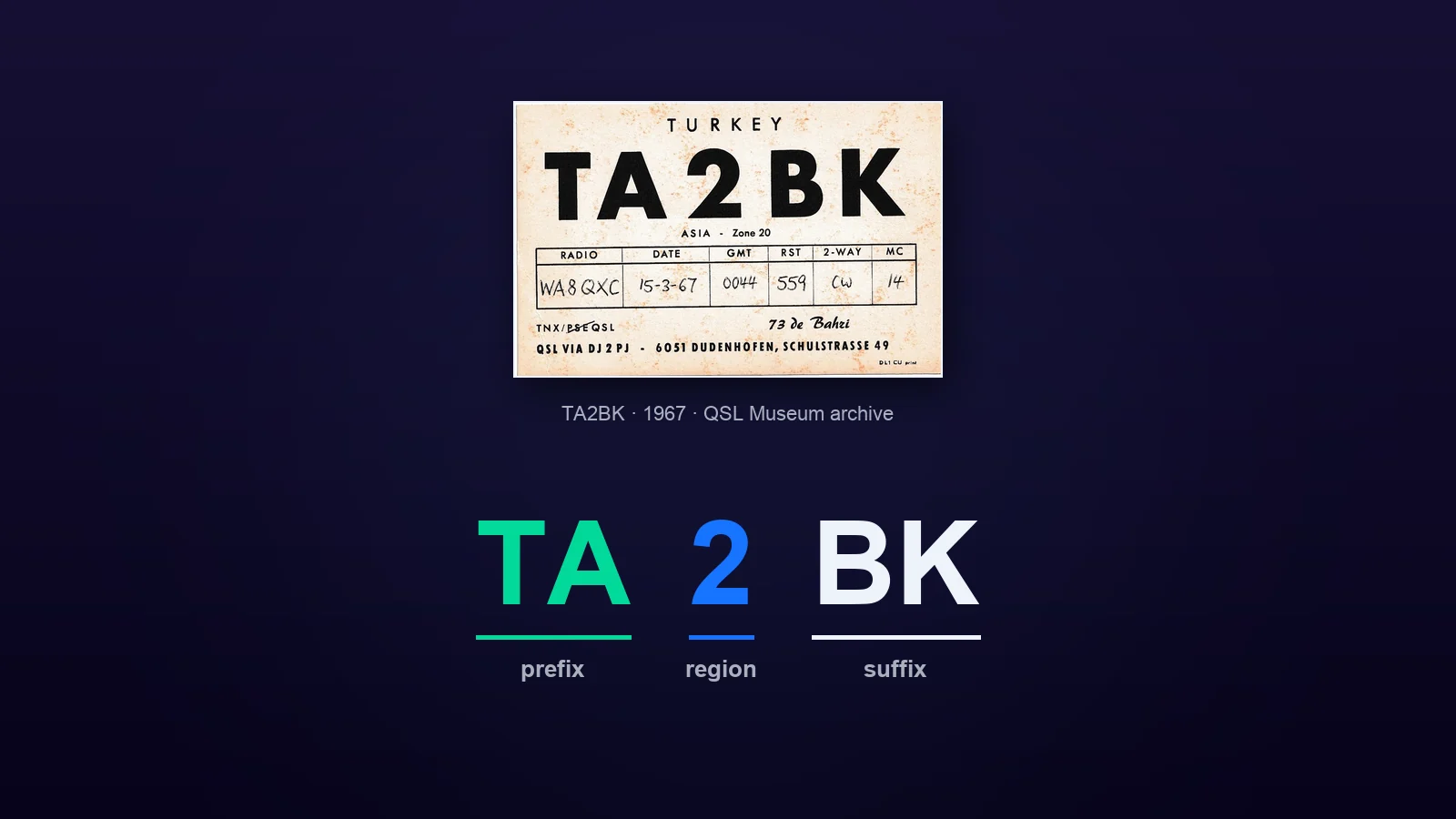
Read a callsign from left to right: first the prefix, then the numeral, and finally the suffix. In TA2BK, the structure separates as TA | 2 | BK. Reading these parts, however, involves more than dividing letters. The card's period, operator and place of operation must also be considered. Real cards in the QSL Museum clearly show how the same structure appears with short and long suffixes or with slash notation.
First separate the three parts visually
The basic reading order is:
- Prefix: The letter or group of letters at the beginning of the callsign. The Turkish examples in this article use TA.
- Region number: The numeral following the letter group. In TA2BK, 2 occupies this position; in TA1AR it is 1, and in TA3AA it is 3.
- Suffix: The letters after the numeral. BK is the suffix in TA2BK, AR in TA1AR, and EFA in TA2EFA.
This method provides a quick first reading of a card. Even so, the numeral should not be interpreted on its own as a current, permanent city code. The archive's TA3AA Julius Wenglare page records that the operator used the same TA3AA callsign from both İzmir and Ankara. The place, date and operator information on the card are therefore as important as the callsign.
TA2BK: TA | 2 | BK
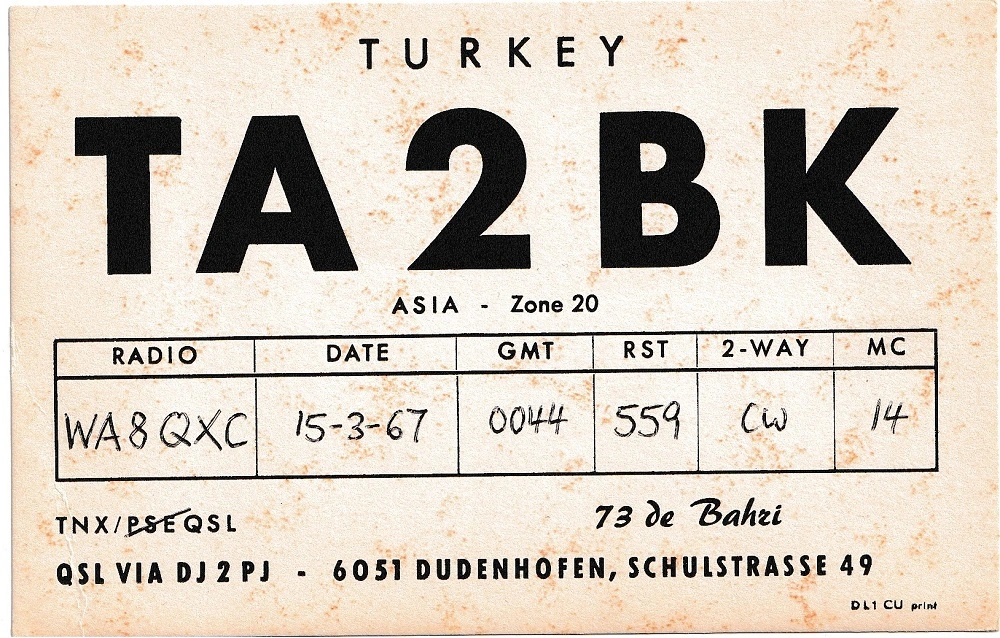
On the archive page for TA2BK Bahri Kaçan, we can divide the callsign into three parts:
- TA: prefix
- 2: region number
- BK: two-letter suffix
The page documents that Bahri Kaçan used TA5EE after arriving in Turkey and later operated as TA2BK for many years. The fact that the same operator also worked under other callsigns, including YU1BKL and DJ0UJ, offers an important lesson: a callsign is not a name that necessarily remains unchanged throughout an operator's life. When identifying a card, record the callsign, period and operator's name together.
TA1AR and TA1AC: same beginning, different suffix
Placed side by side, TA1AR and TA1AC make the suffix's distinguishing role easy to see:
- TA1AR = TA | 1 | AR
- TA1AC = TA | 1 | AC
Both callsigns begin with TA1; the final two letters distinguish them. Card images on the TA1AR Yalçın Kılan page clearly show the TA1AR spelling. The page title also identifies the later use of TA0A with the note “Ex.TA1AR”.

On the card shown on the TA1AC Çetin Şener page, the same structure ends with the suffix AC. The safe conclusion from this comparison is that when the suffix changes, the callsign is different even if the prefix and numeral are the same. Omitting the final letter when cataloguing a card would mix up two distinct records such as TA1AR and TA1AC.
TA2EFA: what does a three-letter suffix look like?
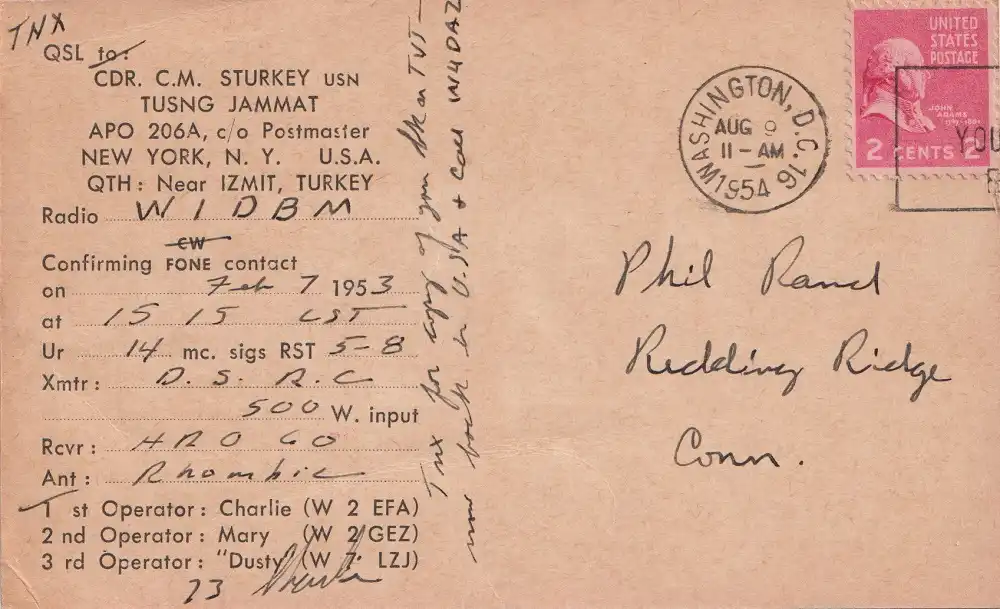
A suffix does not always contain two letters. The callsign on the TA2EFA Charles M. Sturkey page separates as follows:
- TA: prefix
- 2: region number
- EFA: three-letter suffix
The archive page records that TA2EFA was used by Charles M. Sturkey, an American naval officer and amateur radio operator stationed in Turkey, and that his wife Mary Sturkey was the station's second operator. This card also shows that a callsign alone does not reveal the operator's nationality. As the archive explicitly states, TA2EFA here belongs to activity in Turkey, while the operator was American.
W0SO and the slash: identify the main callsign first
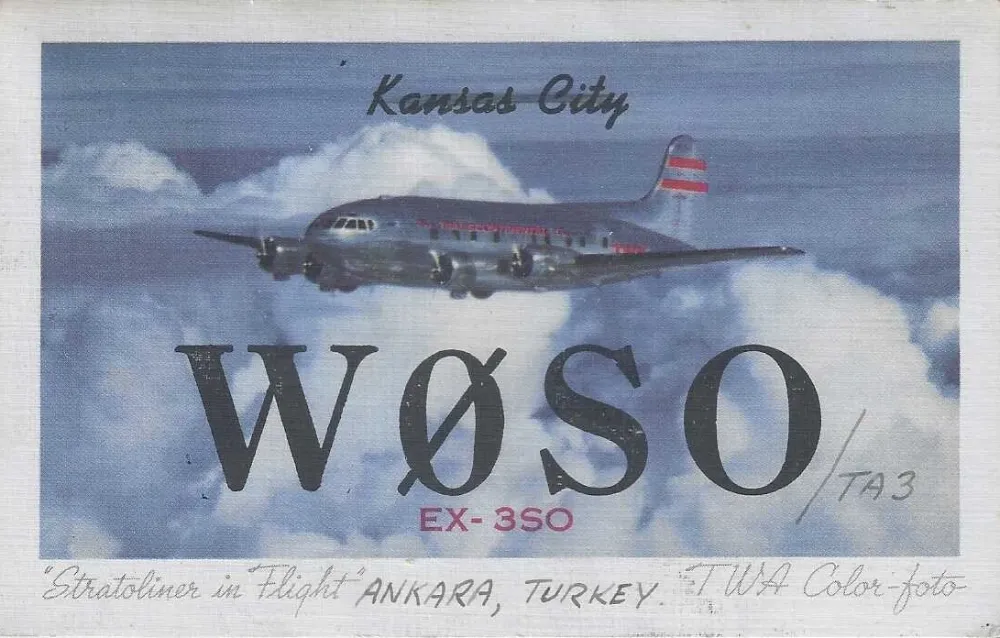
For comparison with the Turkish examples, see the W0SO/TA3 Philip W. Morrell page. The archive describes Philip Morrell as an American amateur radio operator and lists W0SO among the callsigns he used. The main callsign separates visually as W | 0 | SO:
- W: prefix
- 0: numeral
- SO: suffix
The W0SO/TA3 notation in the page title also teaches us to view the part added after the slash separately from the main callsign. When examining such notation, first read W0SO in full, then record the TA3 part after the slash exactly as written. The archive page documents Morrell's connection with Ankara and the Ankara-postmarked stamps on the card. It is safer, however, to stay with the card's own record than to infer a broader regional rule from this added notation.
A quick reading order for a card
When examining a callsign on a QSL card, use this sequence:
- Copy the callsign exactly as it appears on the card, in uppercase.
- Separate the letter group on the left, the numeral in the middle and the suffix on the right.
- If there is a slash, note the added part separately without altering the main callsign.
- Check the operator's name, place of operation and date on the archive page.
- On cards with the same prefix and numeral, compare the suffix letter by letter.
- Do not infer a city or country from the numeral alone; rely on the card's catalogue record.
This method lets you parse TA2BK, TA1AR, TA1AC, TA2EFA and W0SO at a glance. A truly reliable reading emerges when you combine the callsign's three parts with the information on the card and the verified archive record.