


The first clue to where a callsign comes from is its opening prefix. This list is not copied from a ready-made country table; it is compiled solely from real cards whose country or location is clearly identified in the QSL Museum. Its purpose is not to catalogue the entire world, but to offer a reliable starting point through matches visible directly in the archive.
How should you read the list?
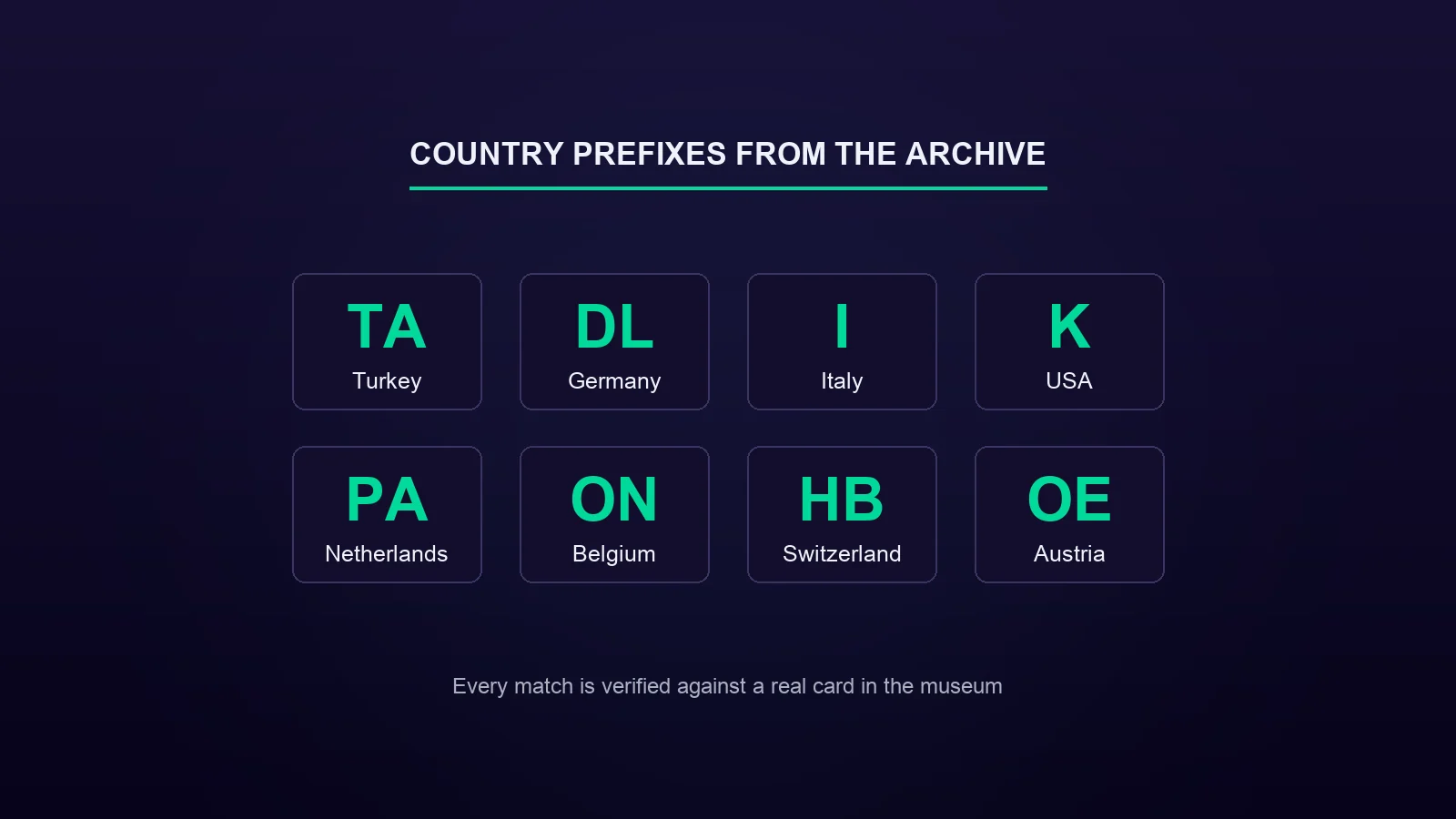
Each item gives the prefix or prefix group shown on a museum page, followed by the country and an example callsign. The link leads to the archive page containing the card. In DL3JPN, for example, we use “DL” to identify the country; in HB9DSY, we use “HB”.
Do not treat the numeral as an unchanging part of the country code. On the Germany, Italy and United States pages, examples beginning with the same letter group but different numerals appear side by side. This article does not explain regional or licensing details represented by numerals; it shows only the country-prefix matches explicitly supported by the archive.
Country prefixes verified in the archive
- TA — Turkey — TA2BK card. The operator page states that Bahri Kaçan used TA5EE and later TA2BK after arriving in Turkey. Several sides of TA2BK cards can also be viewed there.
- DB, DC, DD, DE, DF, DG, DH, DJ, DK, DL, DM, DO — Germany — DL3JPN example. These groups have separate headings, with cards from DB0OHA to DO9PT.
- I, IK, IQ, IZ — Italy — I3KAN example. The four groups appear in separate sections. IK3PQG, IQ3VE and IZ3ZLT are other examples.
- K, W, WA — United States — K3ZO example. The page presents K0–K9, W0–W9 and WA0–WA9 in separate sequences. W3DIY and WA3UTC also appear.
- PA — Netherlands — PA3RW example. The page contains cards from PA0RHA to PA9JO, making a same-country sequence easy to recognize from the first two letters.
- ON — Belgium — ON7NDR example. ON7NDR, ON7ZZ and ON6DP appear with different regions; ON4LBI, ON2WAC and ON3BS are also shown.
- HB — Switzerland — HB9DSY example. HB9DSY appears under Zurich, HB9DNF under Bern and HB9UU under Geneva; HB3YKU is in the same collection.
- OE — Austria — OE1PDB example. A sequence from OE1PDB to OE9WPV directly shows OE under the Austria heading.
- LA — Norway — LA3QPA example. LA0CX, LA1YKA, LA3QPA and other LA cards appear together.
- OH — Finland — OH2BAD example. The page contains examples from OH1LA to OH9BS, including OH4GGW and OH8R.
- OZ — Denmark — OZ3BJ example. OZ0MJ, OZ1KJG, OZ3BJ and other OZ cards appear there. AL3T is a separate callsign; this match is limited to explicit OZ examples.
- SP — Poland — SP5X example. The page contains callsigns from SP1FRC to SP9FOW.
- YO — Romania — YO3HBK example. YO2ADQ, YO3HBK, YO4AH and further examples appear under Romania.
- HA — Hungary — HA5AQ example. Cards from HA0HV to HA9PP appear in the same country collection.
How can you check a callsign using a card?
Compare the first one or two letters with the list, then open the link and check both the callsign on the card and the country heading. For PA3RW, “PA” leads to the Netherlands; for YO3HBK, “YO” leads to Romania.
Callsigns containing a slash require extra care. PH7FE on the Austria page appears with OE in the image filename, but this article bases the Austrian match on explicit OE1–OE9 cards. An operator may also use different callsigns in different countries: the TA2BK Bahri Kaçan page mentions callsigns beginning with TA, YU and DJ in one biography. An operator’s name alone is therefore not proof of country.
Why is this list not complete?
As the archive grows, new countries and prefix examples may be added. The criterion is verifiability: the country name must appear clearly on the archive page, and the example callsign must be on a card there. Possible matches that do not meet this condition were excluded.
Use this page not as an official, complete allocation table, but as an exercise in reading callsigns through QSL cards. On the next card, find the prefix first, then compare it with a real example on the museum’s country page.